Aged Beauty Inventory at Amazon FBA: What the Surcharge Costs and Your Five Ways Out
Amazon's aged inventory surcharge starts at day 181 and quadruples at day 271. For beauty, shelf life is draining at the same time. What each exit pays, and when to pull the lot.
Oct 23, 2026 · Jenny Parker · 7 min read
If you sell beauty on Amazon, the aged inventory surcharge is the fee that quietly decides whether a slow SKU is still worth holding. It starts the day a unit passes 180 days in a fulfillment center, climbs every month after that, and for cosmetics it collides with a second clock — shelf life — that most fee guides ignore. This article is for brands and FBA sellers holding skincare, makeup, hair care or fragrance that has stopped moving: what the surcharge actually costs, what Amazon's own exit routes pay, and when it makes more sense to pull the stock out and sell the whole lot at once.
Two clocks, not one
Every FBA seller watches inventory age. Beauty sellers have to watch remaining shelf life at the same time, because the two run in opposite directions. A serum that sat 200 days in a fulfillment center has not just picked up a surcharge — it has lost 200 days of the window in which an off-price buyer will pay real money for it. Past roughly twelve months of life remaining, the price per unit starts falling fast; under six, most buyers pass. (We cover the thresholds in how much shelf life you need left to sell short-dated skincare.)
So the real cost of a slow beauty SKU is the surcharge plus the value the stock is losing each month it ages. Looked at that way, the right time to act is usually earlier than the fee table alone suggests.
What the aged inventory surcharge costs in 2026
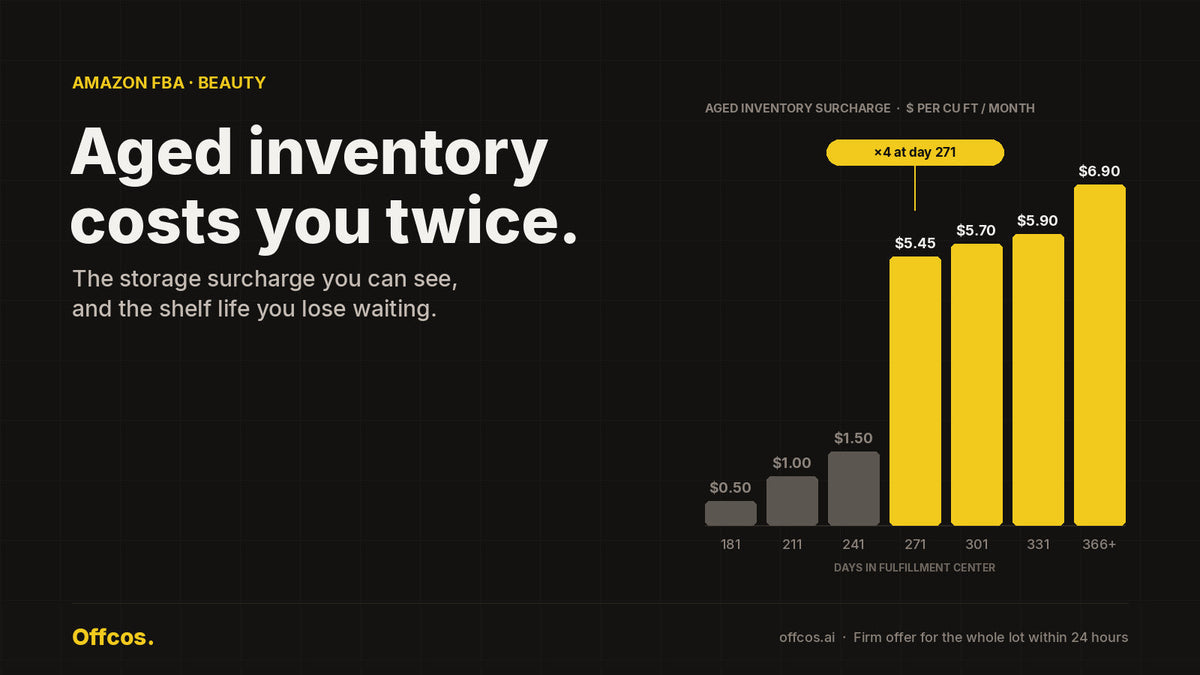
Amazon's US schedule charges the surcharge monthly, per cubic foot, on top of normal storage. As of early 2026 the tiers published by Amazon are, roughly:
- 181–210 days: $0.50 per cubic foot
- 211–240 days: $1.00
- 241–270 days: $1.50
- 271–300 days: $5.45 — this is the jump that hurts
- 301–365 days: $5.70 – $5.90
- 366+ days: $6.90 – $7.90, or a per-unit minimum of $0.30 – $0.35, whichever is greater
Rates change; check the current fee page in Seller Central before you model anything. But the shape is what matters: the fee is a nuisance for the first three months, then roughly quadruples at day 271. For small beauty units the per-cubic-foot figure looks harmless until you multiply it by a pallet of gift sets or a case count in the thousands — and it compounds with the shelf-life loss described above.
Amazon's four exits, and what each one pays for beauty
1. Discount and advertise it down
Works for a SKU that is merely slow. Does not work for a discontinued shade, a reformulated line, or anything whose listing has lost the Buy Box. And every week spent testing a lower price is another week of age and shelf life gone.
2. FBA Liquidations
Amazon's built-in liquidation program sells your units to wholesale liquidators. Typical gross recovery is about 5–10% of the average selling price, before a 15% referral fee on that recovery and a processing fee. Payment arrives in roughly 60–90 days. Storage and surcharges stop once the liquidation order is accepted, which is the program's real benefit. The downside for beauty is control: you do not choose the buyer, you do not set resale terms, and the units can reappear on the same marketplace at a price that undercuts your own listing.
3. Removal order
Amazon ships the units back to you (or to an address you name) for a per-unit fee based on size and weight. Processing can take up to 14 business days, longer in peak season. This costs money and does not solve anything by itself — but it is the first step toward the one route that actually protects a beauty brand, below.
4. Disposal
The cheapest click and the most expensive decision. Sealed cosmetics with shelf life left have a buyer somewhere; disposing of them turns a recoverable asset into a write-off. Disposal is appropriate for expired, damaged or recalled product — not for overstock that simply aged in a warehouse.
The fifth exit: remove, then sell the whole lot once
For beauty specifically, the route that usually returns more than FBA Liquidations — while keeping control of where the product ends up — is to remove the inventory and sell it as a single lot to an off-price buyer that works under your terms.
Why it tends to pay better:
- One price for everything. Slow SKUs, odd shades and partial cases that Amazon's liquidators discount hardest are priced as part of the whole lot, not one by one.
- You set the resale rules. Export only, no online marketplaces, brand name withheld from listings — written into the contract. FBA Liquidations offers none of that. We explain why this matters for domestic pricing in why exporting excess beauty stock protects your pricing.
- Shelf life is priced honestly. A buyer who exports to markets with faster sell-through will pay for nine months of life that a domestic liquidator treats as nearly worthless.
The trade-off is the removal fee and a few weeks of logistics. Against a day-271 surcharge jump and a 5–10% liquidation recovery, that trade-off is usually easy to justify for any lot bigger than a few cartons.
A simple decision rule
Run this on each slow beauty SKU at the 150-day mark, before the surcharge starts:
- Is the listing still healthy and the product still current? If yes, discount and advertise for 30 days. If no, skip to step 2.
- Is remaining shelf life above 9 months and the sealed quantity above one pallet (or ~500 units)? If yes, remove and sell the lot. If shelf life is 6–9 months, do it now rather than next month.
- Is it under 6 months of life, or a few dozen units? FBA Liquidations is the pragmatic answer — accept the low recovery and stop the fees.
- Expired, damaged, recalled? Dispose, and document it.
The mistake we see most often is sellers reaching step 2 at day 300 instead of day 150. By then the surcharge has quadrupled and the stock has lost five months of life. Both of those are avoidable with a calendar reminder.
What a buyer will ask you for
If you take the removal route, have these ready before the goods leave Amazon — it shortens the time between removal and payment:
- SKU-level list with quantities, UPCs and expiration or PAO dates
- Condition: sealed vs. opened, carton condition, whether units are still in Amazon prep (poly bags, FNSKU labels)
- Where the goods will land after removal, and when
- Your resale terms — the markets, channels or platforms you want excluded
Our inventory list checklist covers the full format.
Quick answers
Does FBA Liquidations stop the aged inventory surcharge?
Yes — once Amazon accepts the liquidation order, storage fees and surcharges stop for those units. That is the program's main advantage. The recovery itself is low.
Can I sell beauty inventory that is still in Amazon prep — poly bags, FNSKU labels?
Usually yes. Tell the buyer up front; most off-price and export buyers relabel anyway. Opened or tester units are a different conversation and should be listed separately.
Is it worth removing a small quantity?
Below a few cartons, the removal fee and freight eat most of the gain. Combine slow SKUs into one removal and one lot, or let FBA Liquidations take the small remainder.
What if the same product is also sitting in my own warehouse?
Sell both together. One combined lot with one price is simpler for the buyer and almost always worth more per unit than two separate deals a month apart.
The surcharge is the fee you can see. The shelf life you lose waiting is the one that actually costs you.
Holding aged beauty inventory at Amazon? Send us the list — one firm offer for the whole lot within 24 hours, paid in full before pickup, sold only under the terms you set.
#Offcos #Offcos.ai #AmazonFBA #AgedInventory #BeautyLiquidation #ExcessInventory #FBARemoval #OverstockCosmetics #BrandProtection
Turn dead stock into working capital.
Tell us what you have. You get a firm offer within 24 hours, and you are paid before anything leaves your warehouse.